


If your TikTok strategy targets a global audience, translation is no longer optional.
But here’s the problem. TikTok now offers auto captions, translations and even AI dubbing. On the surface, it looks like global content is solved.
In reality, most brands are still getting it wrong.
Because visibility is not the same as understanding.
In this guide, we break down how TikTok translation actually works today, where AI tools fall short and how to build a workflow that protects both reach and brand consistency.
Here’s our recap:
Benefits of adding subtitles to TikTok videos
While not as prevalent on TikTok as on other platforms, many users watch videos without sound. This is why adding subtitles, generally called captions on TikTok, to all videos with talking audio is essential.
“Having subtitles on your videos makes it easier for your audience to continue watching and to get your message across.”
– Paula Uccelli, Project Manager at VeraContent
Adding captions improves both accessibility and discoverability.
TikTok uses captions, spoken audio and on-screen text to understand what your video is about. This helps the algorithm match your content to the right audience and search queries.
However, not all captions carry the same weight. Text added directly in TikTok provides stronger signals than subtitles added before upload, as it is easier for the platform to process and index.

Captions also make things easier to understand. This is especially helpful if the people in your videos have accents unfamiliar to everyone. When it’s hard to understand the accent by listening, reading the captions can really help.
This is why we add captions to all videos we create for Ria Money Transfer’s TikTok account. They use local creators from their key target markets to make videos that feel familiar and relatable to those specific audiences—thanks to their accents and local flair. But with captions, everyone from different areas can still enjoy and understand them.
Here’s an example:
@riamoneytransfer Ria adapts to all your needs with three methods to transfer money. Remember to visit our website to see where the app is available and our Ria store locations. #ria #moneytransfer #stores #app #website #moneymindset #2024tips #riatoptips#CapCut ♬ Lisztomania – Phoenix
In general, captions help to keep viewers interested for longer, making them more likely to share and follow what you post.
See also: Promoting your global brand with TikTok influencer marketing
Should you translate your TikTok captions?
Users typically add captions in the same language as the video. But are there benefits to translating those captions?
Beyond breaking down language barriers, translating your TikTok videos makes your content more accessible. But it’s up to you who you want them to be accessible for.
For example, if your audience is majority English speakers (even if non-native), you’ll need to ensure any non-English audio is translated in the captions.
Here’s an example from Ria Money Transfer, where the local creator incorporates English and French. Since this is for a global TikTok account, we translated the French parts to English in the captions.
@riamoneytransfer Important tips on how to keep your online accounts safe. #onlinesafety #security #moneysafety #ria #riamoneytransfer #password #toptips #foryoupage #fyp #accountsafety ♬ Cloudy Love – Wahyu
However, if your target audience doesn’t speak English and your content is in English, it’s beneficial to add translated captions in whichever language you’re targeting.
This TikTok marketing strategy helps you repurpose content from your global account to your regional accounts.
Typically, you’d only include captions in one language. It tends to get messy adding more than one set of captions. Of course, there are exceptions.
For example, the language app Speak has successful Korean and Japanese TikTok accounts, where they include both English and Korean/Japanese captions in the videos. This works as the videos are all language lessons, so both languages are essential.
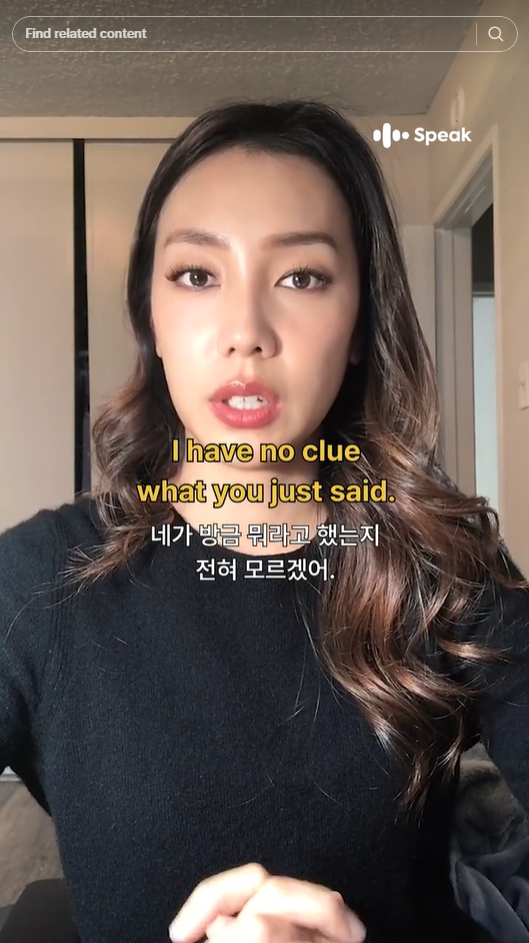
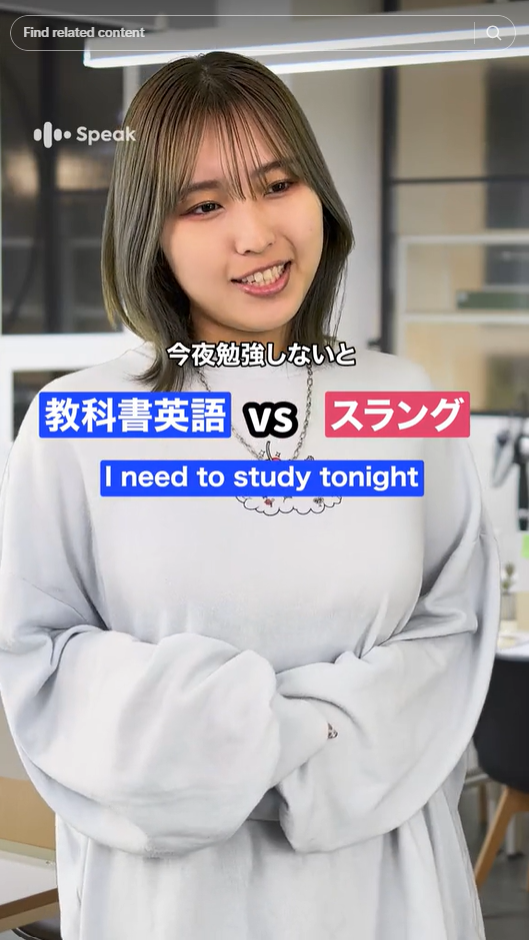
Examples of Speak’s TikTok accounts in Korean (left) vs Japanese (right).
TikTok SEO and search behavior
TikTok is no longer just a social platform. It’s become a search engine, particularly for Gen Z and millennial audiences.
Users are actively searching for:
- how-to guides
- product reviews
- recommendations
- answers to specific questions
This shift changes how content needs to be created. It’s no longer just about grabbing attention, but about being discoverable.
How TikTok search works
TikTok uses a combination of signals to understand your content and decide when to surface it in search results or on the For You page.
The most important signals include:
- spoken words in your video
- on-screen text added within TikTok
- captions and subtitles
- hashtags and keywords in your caption field
- engagement signals such as watch time, shares, and saves
Unlike traditional SEO, TikTok relies heavily on audio and visual context. This means what you say in your video is just as important as what you write.
If your content clearly communicates a topic across all these elements, TikTok can more confidently match it to relevant searches.
How to optimize captions for discoverability
Captions play a central role in helping TikTok interpret your content.
To improve discoverability:
- Include relevant keywords naturally in your captions
- Match captions to what is being said in the video
- Reinforce key phrases with on-screen text
- Keep language clear and easy to understand
- Avoid overloading captions with unnecessary text
Consistency is key. When the same keyword appears in your spoken audio, captions and on-screen text, it sends a strong signal to the algorithm.
It’s also best to add captions directly within TikTok. Native text is easier for the platform to process and tends to perform better than subtitles added before uploading.
Why this matters for global brands
For brands creating content across multiple markets, TikTok SEO becomes more complex.
You need to ensure that:
- Keywords are relevant in each language
- Phrasing matches how people actually search locally
- Content feels natural to the audience
Without this, even well-produced content can struggle to reach the right viewers.
Optimizing for TikTok SEO ensures your content is not only seen, but seen by the right audience.
How to translate on TikTok and add translated captions
Did you know that TikTok has a built-in translation feature? Back in 2021, TikTok introduced captions, allowing creators to add subtitles to their videos, opening up a world of content for everyone, regardless of hearing abilities or language proficiency.
In 2022, they introduced an advanced caption and translation tool. It essentially puts more translation features in the viewer’s hands.
Here’s what’s possible:
- Auto-generated captions: This feature enables creators and viewers to add closed captions to videos automatically. It’s designed to assist viewers in understanding the content without sound, whether due to hearing impairments, noisy environments or personal preference.
- Translations for captions and video descriptions: TikTok offers translations for both captions and video descriptions, aimed at helping users engage with content not in their native language. This feature supports a range of languages, broadening the reach of videos across different linguistic audiences.
- Translation for text stickers: Recognizing the importance of text stickers in videos, TikTok has also introduced translation for this element. This ensures that all aspects of a video, including text-based jokes or comments, are accessible to non-native speakers.
- AI voice dubbing: The platform is rolling out AI voice dubbing. This allows videos to be automatically voiced in another language, making content more accessible without requiring subtitles.
The initial launch supports translations in multiple languages, including English, Portuguese, German, Indonesian, Italian, Korean, Mandarin, Spanish and Turkish.
This is what it looks like:
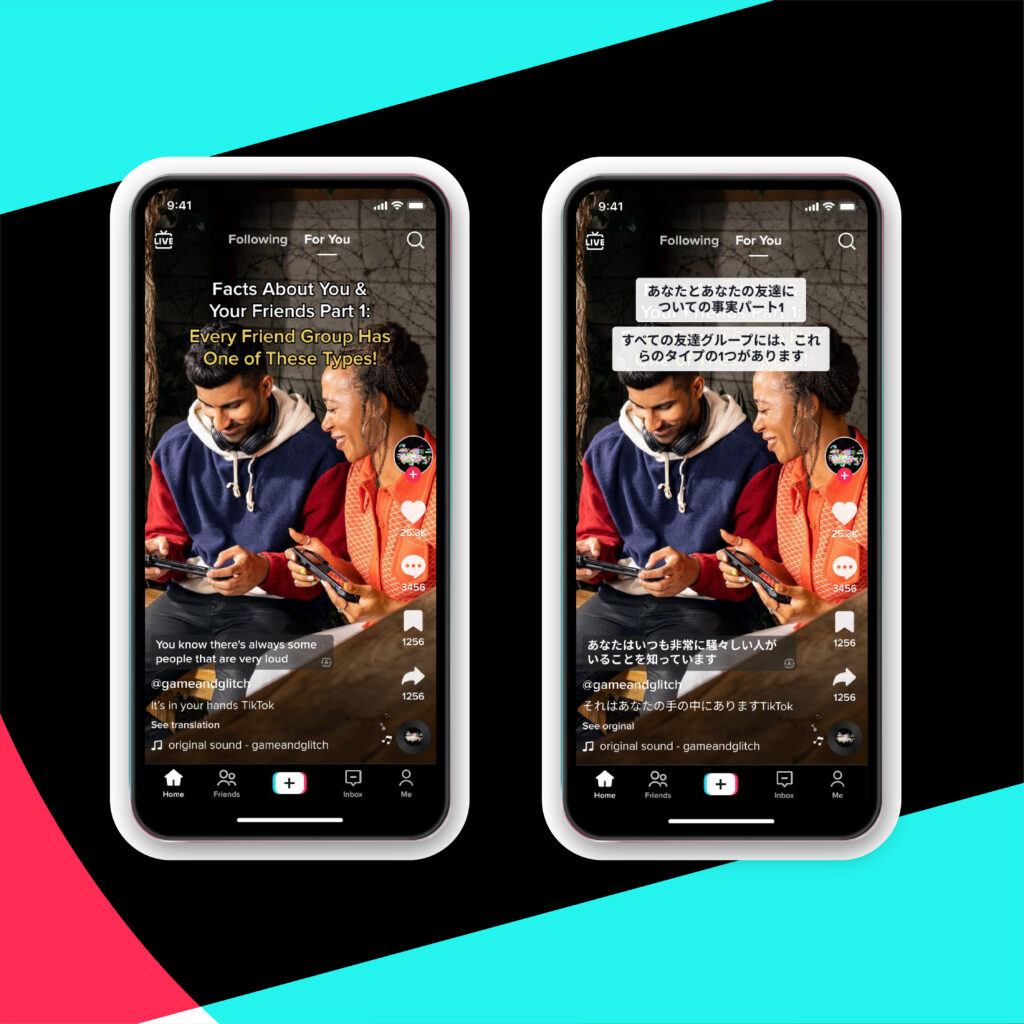
However, while these features sound great, they’re not always consistently surfaced or used. And, even if available, viewers may not know that they exist. Since users need to activate it in their settings, many aren’t using this feature.
This gives the responsibility back to brands specifically targeting different language groups to translate the TikTok videos themselves.
There are two ways to do this: You can add these with third-party tools, like CapCut, or manually add them using the Add Text feature inside the TikTok editor.
Both are good options that give you more control over where your captions appear on the screen—compared to TikTok’s auto caption feature.
Using TikTok’s Add Text feature helps your videos appear in searches and on the right people’s For You pages because the platform’s algorithm can read the text.
See also: Subtitling translation: 5 tips for global video content creators
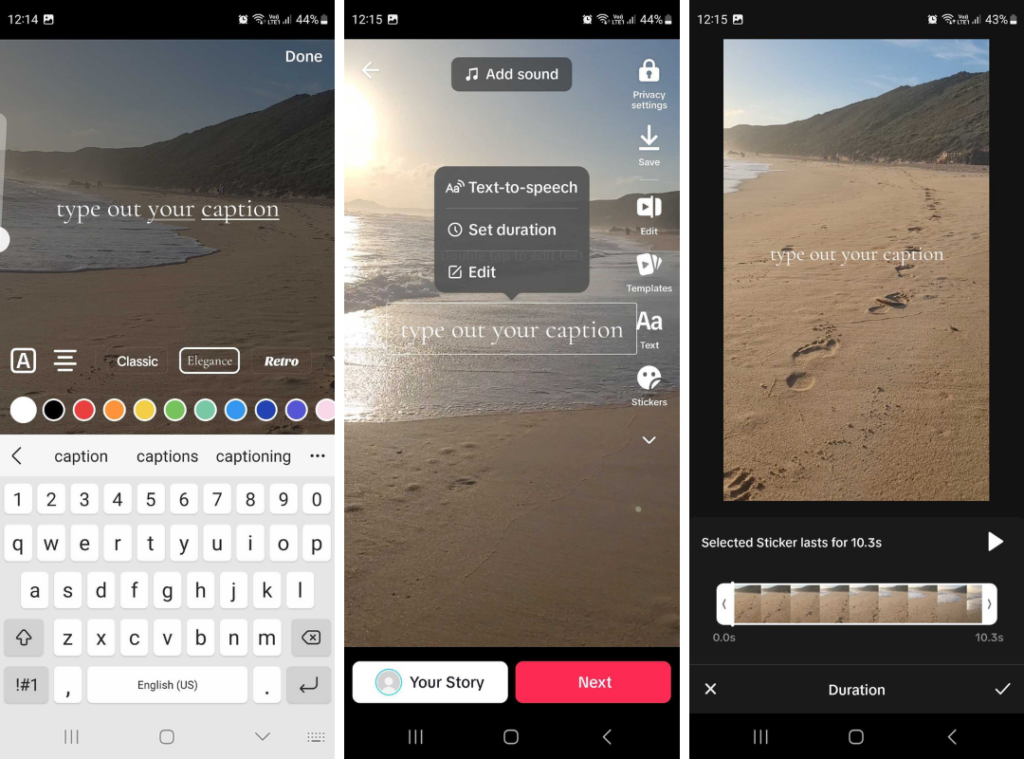
Here’s how to manually add captions on TikTok:
- Record/upload video: Record your video in the TikTok app or upload an existing one. Complete your recording or uploading, then tap the check mark to proceed.
- Access text feature: Use the “Aa” icon to add manual captions to your video.
- Type captions: Manually type out your video subtitles for more creative control.
- Time captions: Set when captions appear and their duration by tapping the text, then the “Edit duration” button, and adjusting with the slider.
- Style captions: Customize the look of your text to make your videos stand out and maintain a consistent style across your TikTok content.
How to enable/turn on TikTok translate as a user
To enable language settings and translations on TikTok, follow these steps:
- Open TikTok and click the three lines in the top-right corner of your profile.
- Go to “Settings and Privacy” at the bottom.
- Tap on “Language” to update your language preferences.
- You can select multiple languages for your feed (e.g., English and Spanish).
- Enable “Show Translations” and set your preferred translation language, such as translating Spanish content to English.
This allows you to view content in different languages with ease.
Auto-translate TikTok captions vs. human translation
Now that you’re up to speed on adding translated captions on TikTok, the next question is how to create those translations in the first place.
TikTok and other auto-translation tools make this easy. With just a few clicks, you can generate captions and translate them into multiple languages, making your content instantly more accessible to a global audience.
The benefits are clear. These tools reduce effort, speed up production and help scale content across markets.
But accessibility is only part of the equation.
Auto-translation tools, including TikTok’s built-in features, are designed for speed, not precision. They often struggle with nuance, cultural references, slang and tone. The result is content that may be technically correct but feels unnatural or out of place to local audiences.
For brands, this creates a gap between visibility and impact.
At VeraContent, we approach translation differently. It’s not just about converting text. It’s about making content feel native to each market.
That’s why every translation is reviewed by two editors and handled by local, native speakers. This ensures the language is accurate, culturally relevant and aligned with your brand voice.
Because on TikTok, how your message is understood matters just as much as whether it is seen.
See also: Video translation: Auto-generated vs. human translation services
AI vs. human is the wrong question
Most brands treat this as a choice. It isn’t.
The most effective approach is a hybrid workflow:
Step 1: AI for speed
- generate captions
- create first-pass translations
- scale across markets
Step 2: human for quality
- fix cultural nuance
- adapt tone and phrasing
- ensure brand consistency
AI gets you most of the way there. Human expertise ensures the content actually connects.
And this distinction becomes even more important when you consider how content is discovered on TikTok.
Because visibility is no longer just about publishing content in multiple languages. It’s about ensuring that content can be found, understood and surfaced to the right audience.
TikTok is a platform where local relevance is key
Viewers are drawn to content that reflects their experiences, culture and language. They want to see videos they can relate to. If the content feels foreign or disconnected from their reality, engagement drops.
The most successful brands on TikTok are those that create highly relatable content, tailored to the nuances and preferences of each audience. This level of relatability can only be achieved through high-quality translations that understand and respect cultural context.
So, while auto-translate features on TikTok and other tools provide a great first step towards making your content globally accessible, the final touch should always be human. Human translation ensures that your content is understood, appreciated and enjoyed by viewers from different cultural backgrounds.
At VeraContent, we work with local, native speakers and have a rigorous editorial process. This ensures translations do more than just convey a message—they make it resonate. If this is what you want with your TikTok translations, get in touch with our team to find out if you qualify for a Free Content Consultation.
Getting started with managing multilingual social media accounts? Download our complete guide to doing it right:
