



Global brands on LinkedIn face a challenge that goes beyond posting frequency. You’re managing multiple audiences across different languages, cultures and time zones, and a single company page rarely does the job well enough.
This guide covers how to approach social selling internationally on LinkedIn: what it is, how to structure it across markets and what a well-executed global strategy actually looks like in practice.
What is social selling on LinkedIn?

Social selling is a marketing strategy that uses social media to build and nurture relationships with prospective customers, with the goal of converting those connections into leads. You and your brand are presented as credible and capable of solving the problems your customers face.
“The core of social selling is building relationships with human beings, even if they’re behind a screen—and providing them with real value.” – Oliver S. Bauer, Senior Manager of Digital Marketing at Allianz Global Investors
This is different from traditional digital marketing, like display ads or cold outreach, which can feel impersonal. By sharing a mix of content about your brand, your industry and your own perspective, you connect with fewer prospects, but they’re more likely to be the right ones.
Social selling isn’t social media marketing. It’s not about KPIs or adding contacts to a list and sending marketing messages. It takes time to build because the goal is genuine relationships, not immediate conversions.
Social selling works across all major platforms, but LinkedIn’s professional nature makes it particularly effective for B2B companies looking to reach decision-makers. According to LinkedIn, 82% of B2B marketers turn to the platform to generate leads, and 62% say it produces twice as many leads as their next-best performing social channel.
It’s also worth building a substantial network: research from LinkedIn suggests that reps with more than 5,000 connections are significantly more likely to meet their sales quotas than those with smaller networks.
“Our sales force has 10 times the amount of followers as our brand itself does on LinkedIn. If each salesperson has a couple of hundred connections, that can grow exponentially in comparison to the brand.” – Jake Potter, Head of Social Media at Institution of Civil Engineers
LinkedIn is also a platform where individual profiles consistently outperform brand pages for engagement. People want to connect with people. That’s a core principle behind social selling, and it’s worth keeping front of mind as you build your strategy.
See also: AI-powered LinkedIn content strategies for global marketers
Best practices for social selling on LinkedIn
Here are our best practices for connecting with the most relevant potential leads and building your credibility and visibility on the platform:
Optimize your profile
To be seen as a credible voice in your field, your profile needs to match. Fill out every section, use a professional headshot and cover photo, and write a clear headline that states what you do and who you help. For example: “Head of Business Development: helping start-ups go global.”
Keep your About section to one or two paragraphs. Use bullet points for employment history, skills and other list-format information so it’s easy to skim. The goal is to look like a subject-matter expert in your current role, not a job seeker.
Create consistent, valuable content
Re-sharing relevant content is useful, but to be seen as a credible voice, focus on creating original content that gives your audience something specific and actionable. A mix of articles, short posts, videos and infographics keeps things varied. Ask questions in your posts to encourage comments and increase reach.
Avoid direct product promotion in your personal content. It shifts the tone from personal profile to brand page, which is exactly what social selling is trying to avoid.
Consistency matters more than volume. Posting a few times a week is a reasonable baseline, but regular and reliable will always outperform occasional and reactive.
“So much has already been said on LinkedIn. If you comment positively – really add value to the discussion – that’s also content marketing.” – Oliver S. Bauer, Senior Manager of Digital Marketing at Allianz Global Investors
See also: Top 5 LinkedIn content trends for global marketers
Build and interact with your network
Use LinkedIn’s advanced search to find and connect with your target audience. Send personalized connection requests. When someone accepts, engage with their content; react to posts, comment on articles. It makes the relationship feel more genuine.
LinkedIn groups are also worth using. There are over two million active groups on the platform, and being in a group lets you message or connect with members you otherwise couldn’t reach. Don’t just join groups that are relevant to you. Seek out groups your target audience is in, see what they’re discussing, and find ways to add something useful.
“So much has already been said on LinkedIn. If you comment positively, really add value to the discussion, that’s also content marketing.” – Oliver S. Bauer, Senior Manager of Digital Marketing at Allianz Global Investors
A large network can help push your content to new audiences through interactions. But quality matters more than quantity. The connections most likely to become clients are worth more than a high contact count.
Keep an eye on your SSI
The social selling index (SSI) is a free LinkedIn tool that shows how effectively you’re using the platform. It measures four areas: establishing your professional brand, finding the right people, engaging with insights and building relationships.
You can access your own social selling index here.

How is social selling on LinkedIn different for international brands?
Social selling is personal, specific and targeted. For global brands with audiences across different countries and languages, that means finding ways to segment your social selling so the right content reaches the right people.
Localizing your LinkedIn presence is about cultural relevance. Content that feels native to a German audience is likely to be structured, referenced and toned differently to content aimed at an audience in Brazil or Spain. A direct translation won’t get you there.
Having different pages or profiles active in different markets also means your content can be timed appropriately for each audience, and regional pages are more likely to surface in local feeds.
Social selling across markets is a long-term commitment. Building audiences in multiple languages takes time, and you need enough oversight to keep your global brand consistent while each regional presence feels genuinely local.
There are two primary strategies for international social selling on LinkedIn: employee pages and showcase pages.
See also: How to use LinkedIn vertical videos in your global strategy
Employee pages
The most common approach to international social selling is doing it through relevant employee pages by market. If you have target audiences in Argentina and South Africa, for example, you’d have an employee social selling for each of those markets in the appropriate language. The employee should be fluent in the language and familiar with the local audience.
This approach makes it easier to reach people in those markets naturally. Relationships feel more genuine, and local employees are better placed to understand regional pain points and choose the right content for each market.
The employee doing the social selling doesn’t have to be the most senior person in the region. The right choice depends on your industry and what your target audience looks for in a credible voice. Cultural context matters here.
“We need to stop just focusing on CEOs and know that everyone can do what the CEO is doing on social. You’ll be surprised about the amount of likes and comments you’ll get about the post of you going to the park.” – Jake Potter, Head of Social Media at Institution of Civil Engineers
Showcase pages
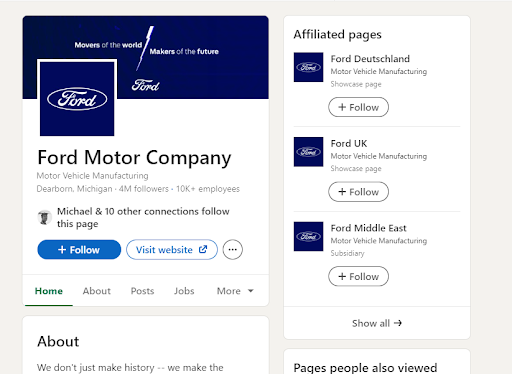
LinkedIn showcase pages are an extension of your main company page that let you spotlight specific brands, regions or initiatives. They have their own URLs and appear as affiliated pages on your main profile. They offer the same posting options and analytics as your main page, and you can assign different admins to each one.
For global brands with a high volume of content across multiple markets, showcase pages help solve a real problem: a single company page can become cluttered quickly, especially when you’re posting similar content in different languages. Showcase pages let you segment your audience clearly and serve each market with relevant content.
Creating a showcase page is straightforward. From your company page super admin view, click Create in the top left and select “create a showcase page” from the dropdown. Fill in the details and you’re done.
A practical note on limits: LinkedIn allows a set number of showcase pages per account, so plan your segmentation carefully before you create them. We’d recommend verifying the current limit directly with LinkedIn’s documentation, as this has changed before. As a general rule, avoid over-segmenting. More pages mean more content to manage and maintain.
See also: Global vs. local social media accounts: How many do you need?
How to align employee social selling with your corporate LinkedIn page

One of the most effective things a global brand can do on LinkedIn is make sure employee content and corporate page content work together rather than in parallel. When an employee re-shares a company post with their own commentary, it reaches a new audience and feels personal. When they post independently on a relevant topic, it builds their credibility and reflects well on the brand.
A few ways to make this work in practice:
- Brief employees on content themes, not scripts. Give them the core message and let them express it in their own voice. Scripted posts are easy to spot and tend to underperform.
- Encourage employees to add their own perspective when sharing corporate content. A sentence or two of personal context is often enough to transform a standard re-share into something people actually engage with.
- Share the company’s content calendar with social selling employees so they know what’s coming. They can plan their own posts to complement, not duplicate, what the brand page is publishing.
- For multilingual markets, make sure the employee social selling in that language has access to localized content, not just translated versions of the global post.
The goal is a consistent brand presence that still feels human at the regional level. That balance is hard to achieve without clear communication between your central content team and the people doing social selling on the ground.
How do I find my social selling index on LinkedIn?
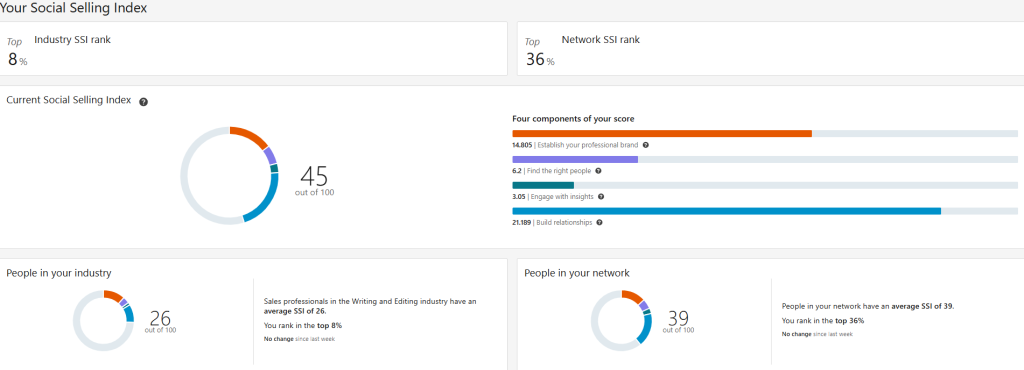
LinkedIn’s Social Selling Index (SSI) is a free measurement tool that shows how effectively you’re using the platform for social selling. It’s worth checking regularly, especially when you’re building out a new strategy or trying to understand why your engagement has changed.
Your SSI is calculated across four pillars, each scored out of 25:
- Establishing your professional brand: the completeness and quality of your profile, plus the engagement your content receives.
- Finding the right people: how effectively you search for and connect with relevant contacts.
- Engaging with insights: how actively you engage with others’ content and how well your own content performs.
- Building relationships: your connection acceptance rate, the quality of your outreach and how often you follow up with your network.
Your total score out of 100 is shown alongside comparisons to people in your network and in your industry. You can access it at linkedin.com/sales/ssi.
One thing worth noting: LinkedIn doesn’t prioritize accounts with high SSI scores in its algorithm. What it measures tends to drive higher visibility because more engagement and more consistent activity naturally increases reach. The SSI is a reflection of good habits, not a shortcut to them.
Ford takes the lead in global LinkedIn social selling
For a concrete example of social selling done well at global scale, Ford is worth looking at. The company operates in over 125 countries and uses a combination of showcase pages and employee profiles to segment its LinkedIn presence effectively. At one point, Ford had 25 showcase pages organized by region and brand.
Where Ford’s approach stands out is in how it uses key employee profiles. Jesús Alonso, president of Ford Iberia, is a strong example. His LinkedIn account is used actively for social selling, mixing Ford content with posts about sponsorships, community events and local initiatives. His posts consistently generate more engagement than the Ford Iberia brand page, even when the content is identical.
In January 2024, the Ford Iberia team ran a targeted campaign through his profile. The Mustang Mach-E, priced at around €64,000, is aimed at senior executives. Getting a CEO to read an unsolicited message is notoriously difficult, so the team took a different approach.
They sent personalized LinkedIn messages to 2,000 Spanish executives, inviting them to test drive Alonso’s personal Mustang Mach-E while he was on a three-week holiday. The Ford Iberia call center was briefed to answer any response calls within 60 seconds, acting as Alonso’s assistant. A fleet of Mach-Es was made available across Spain for delivery on demand.
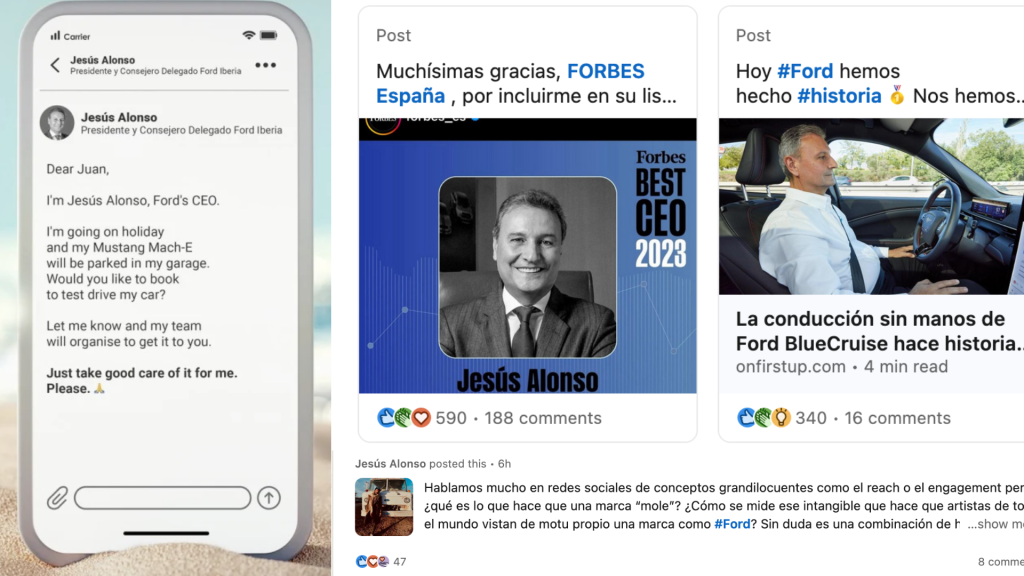
The results were strong. The first test drive was booked less than 60 minutes after the first messages were sent. 72.9% of executives read the message, a 120% higher read rate than normal. Test drive bookings increased 40% compared to previous campaigns.
Alonso’s profile has 21,000 followers compared to the Ford Iberia page’s 9,000. His posts get more engagement across the board. The reason is straightforward: people engage more with individuals than with brand pages.
The broader lesson is clear. A real person as the face of your content, someone who posts authentically, engages genuinely and knows exactly who they’re trying to reach, consistently outperforms a corporate account. But it only works if that person still sounds like a person. A mix of brand content, personal posts and well-targeted outreach is what makes the difference.
International social selling on LinkedIn isn’t a quick-win strategy
It takes time to build credibility, grow the right connections and develop content that feels locally relevant rather than globally generic. But for B2B brands managing audiences across multiple markets, it’s one of the most effective long-term investments you can make in your LinkedIn presence.
The brands that do it well have figured out where human judgment is irreplaceable: in the tone of a post, the choice of a local example, the decision about who should be the face of a regional market. No tool or platform feature replaces that.
If you’re managing LinkedIn across multiple markets and want support with multilingual content production, get in touch with the VeraContent team to talk through what that could look like for your brand.