



Global marketing teams are producing more content in more languages, often with the same headcount as before. AI tools like Claude, ChatGPT and Jasper make drafting faster. The challenge is that speed without structure leads to an inconsistent brand voice across markets.
Without shared inputs, AI defaults to generic marketing language rather than your brand’s. Each region prompts differently, resulting in an inconsistent tone, literal translations and messaging that sounds like five distinct brands.
AI content training solves this by giving your tools the structure they need to produce content that’s aligned to your voice, terminology and market, wherever it’s published.
What multilingual AI content training actually means

Multilingual AI content training doesn’t have to mean building a custom GPT or AI model. It’s about turning the assets you already have into structured AI inputs that guide outputs.
Think of it as onboarding your AI tools, the same way you’d onboard a new team member.
Most organizations already have:
- Brand voice guidelines
- Product messaging guides
- Glossaries and terminology rules
- Approved campaign examples
Multilingual AI content training connects these assets to your AI tools so outputs reflect your own definition of quality in every language.
At VeraContent, this often means translating client style guides into AI-ready formats and embedding the information into tools that teams already use. Instead of relying on ad-hoc prompting, our team works from reusable structures that AI can consistently apply.

Why AI content training matters for global brand consistency
Brand consistency isn’t just visual. It’s also linguistic.
In crowded markets, sounding generic is a massive disadvantage. Brand recognition comes from consistent voice, messaging and terminology, not just logos.
Global content teams balance a lot: keeping brand voice consistent, adapting messaging to cultural cues and staying accurate across languages.
Without clear guidance on what can change and what must stay the same, teams risk either over-standardizing (losing local relevance) or over-localizing (fragmenting the brand).
See also: Digital content localization: A practical guide for global brands
A structured training framework solves this by defining:
- Non-negotiables: tone, positioning and core terminology
- Adaptable elements: examples, cultural references and formality
This allows for localized campaigns that connect with different audiences, while still sounding like one cohesive brand.
“On-brand means different things in different markets, but the core voice has to be recognizable everywhere.” – Naomi Bleackley, Account Manager and AI Marketing Specialist at VeraContent
Structured AI inputs can give your team flexibility within boundaries.
See also: How to use ChatGPT for marketing to a global audience
Where to start with training AI tools for brand voice across languages
An effective AI content strategy turns abstract brand guidelines into concrete, reusable inputs.
Turn your voice into rules and examples. AI responds better to examples than abstract descriptions. Instead of “friendly and approachable,” provide:
- Do/don’t tone examples
- Banned phrases
- Preferred vocabulary
- Positioning lines and main value propositions
- Before and after rewrites of off-brand AI outputs
Many AI tools fall short on terminology. Build a glossary that covers:
- Product names and capitalization rules
- Untranslatable terms
- Market-specific translations
Each market will come with its own cultural and linguistic variables. Create a local nuance pack that covers:
- Formality levels
- Taboo topics
- Competitors
- Cultural references
- Messaging sensitivities
Documenting these points as structured inputs helps AI generate market-appropriate drafts without fragmenting the brand. You’ll also reduce revisions, making your organization’s content team more efficient. This will ensure your technical and branded language stays consistent across markets.
To ensure consistency across repeated content types, create reusable prompt templates. For example:
- Blog outline templates
- Social posts by platform
- Product descriptions
- Email formats
- Testimonial formats
Even a shared document is enough to get started, and it will reduce your organization’s duplicate work. The value comes from consistency.
See also: How AI localization helps marketers—and how it doesn’t
Using your training documents in ChatGPT and Claude
Once you’ve built your style guide, glossary and prompt templates, the next step is making them accessible inside the tools your team uses every day.
Both ChatGPT and Claude offer a Projects feature that lets you upload documents directly into a persistent workspace. Once uploaded, the tool references those documents across every conversation in that project. That means your brand voice guidelines, banned phrases and terminology rules are always in play, without your team having to paste them into every prompt manually.
To set this up, create a dedicated project for each brand or market you manage. Upload your core documents: your style guide, glossary, any tone-of-voice examples and your prompt templates. From that point, every output the tool generates will draw on those inputs as a baseline.
A few things to keep in mind. The quality of your outputs depends on the clarity of your uploaded documents. Vague guidelines produce vague results. The more specific your rules and examples, the more useful the tool becomes. It’s also worth reviewing outputs regularly, especially in the early stages, to check whether the tool is applying your guidelines correctly. Adjust your documents as needed.
This is a low-effort setup that pays off quickly, particularly for teams managing multiple markets or content formats at once.
Putting your AI content training into practice
At VeraContent, we needed a way to keep our global content team aligned across multiple project types for our client, IE University. We’ve worked with the brand for many years, building an extensive style guide that covers multiple university departments. With that level of complexity, consistency required more than manual proofreading.
With this in mind, we embedded the style guide into Grammarly, first converting each point into simple “this or that” rules. The tool now detects errors, suggests improvements and is well-embedded in the processes our international team uses.
As the style guide is updated, so are the Grammarly rules.
However, the AI training is only half the process. Project management and workflows matter just as much.
To avoid duplicated work, we established clear ownership around:
- Who owned governance of AI tools
- Which tools we would and wouldn’t use as a team
- How to avoid over-reliance on Grammarly’s suggestions
Sharing knowledge across the team meant the master style guide was accurate before it went into any tool. Keeping the team in the loop protects the meaning and credibility of our clients’ brands, without slowing things down.
We recommend organizing projects by brand, market and content type to avoid inconsistency across markets and formats.
A typical workflow includes:
- AI draft generation using trained prompts
- Native-language review by local experts
- Brand validation against style rules
- Creation of reusable templates
- Performance tracking
- Continuous refinement of prompts and guidelines
See also: AI content analysis: Tools to measure marketing performance
Measuring and improving your AI content over time

AI content training shouldn’t be static. Teams need a measurement framework that tracks both operational and market outcomes to keep improving over time.
Quality assurance and evaluation are what close the loop when you bring AI into your content workflow.
Consider tracking the following:
- What percentage of AI drafts require major rewrites?
- How frequent are terminology errors?
- Is the tone deviating over time?
- Are efforts still being duplicated across markets?
Over time, your AI content should improve and demand less time-consuming intervention from your in-house team.
Ultimately, your content is there to serve your business goals. Once you’ve embedded AI into your content strategy, evaluate how it’s supporting your organization beyond the content team.
- Has AI use impacted your platforms’ engagement rates?
- Is conversion consistent across languages and markets?
- Is your localized content seeing the same results as the original?
You’re not aiming for identical performance across markets, but significant gaps can indicate your content isn’t landing with your audience.
Remember, your AI training is iterative. It should evolve alongside your brand strategy and market goals.
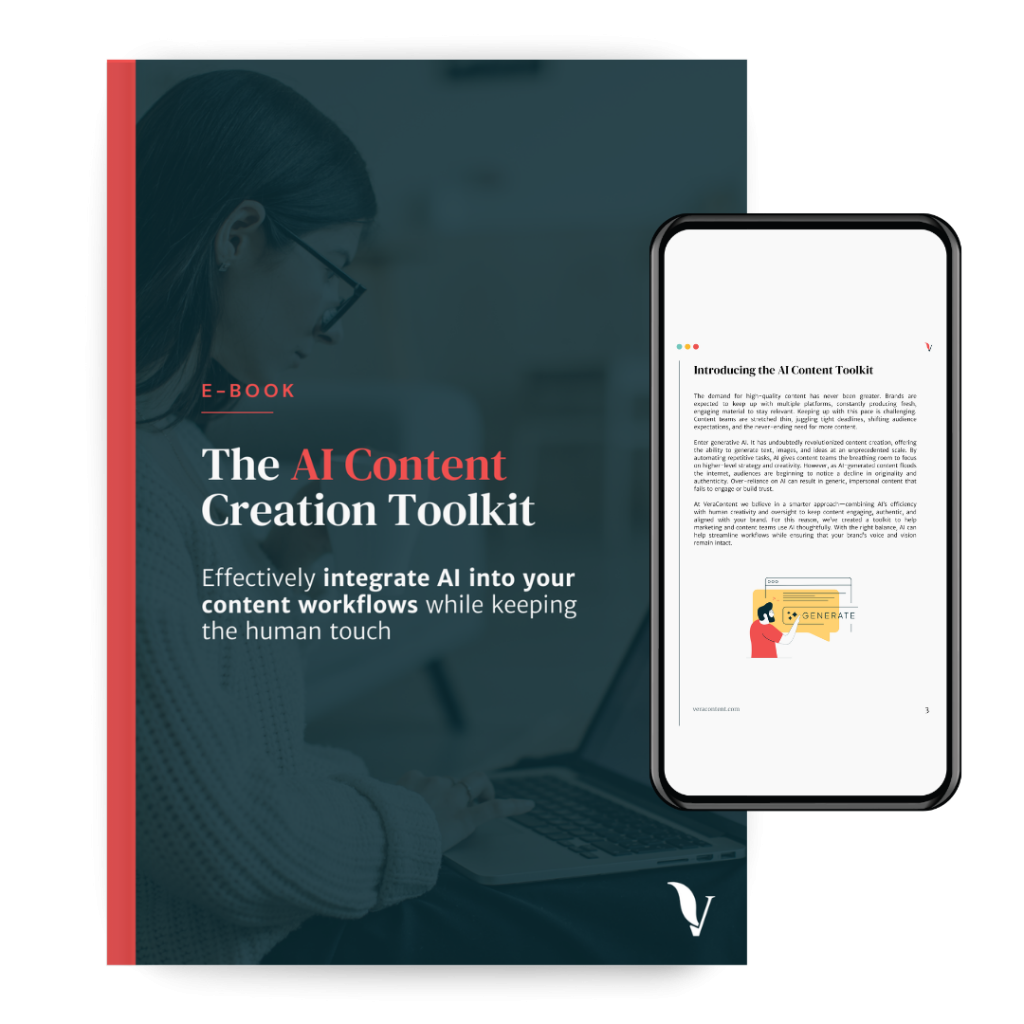
Download our AI Content Creation Toolkit for a complete guide to integrating AI into your content workflows.
Build once, reuse everywhere
Once a multilingual AI training pack becomes part of your organization’s infrastructure, it can be reused across markets, content formats and campaigns. As the brand evolves, the inputs evolve with it.
AI tools speed up the drafting phase, but your people remain accountable for brand voice and cultural accuracy. With AI handling the first draft, their role shifts to reviewing, refining and ensuring accuracy. That’s the part that needs people who genuinely know your brand.
AI works best when it supports structured workflows, rather than replacing them. Local experts protect meaning and credibility.
By turning style guides, glossaries and examples into structured inputs, global teams can scale content without diluting their brand voice, reduce revisions and duplication and deliver culturally relevant messaging across every market.
Ready to build a consistent multilingual content workflow with AI? Book a call with the VeraContent team.