



Expanding into international markets changes everything.
Suddenly, marketing is no longer about one audience, one language or one channel. It becomes a coordination effort across regions, cultures and teams.
Many brands assume the next step is hiring a global marketing manager. But is one person enough? Or does international growth require something bigger?
Let’s break down what a global marketing manager actually does and whether an in-house hire, freelancer or global marketing agency is the right move for your brand.
See also: Multilingual content marketing: Your essential guide
What is a global marketing manager?

A global marketing manager plans and implements marketing campaigns across multiple regions. They are responsible for promoting the company’s brand to international markets, while strategically adjusting their messaging and content to each target audience.
An international marketing manager should not only organize and execute marketing campaigns in existing global markets, but also research potential new markets where their brand could have success.
In short: A global marketing manager coordinates international campaigns, while an agency provides a team that delivers strategy, execution and localization across markets.
See also: Global content marketing: Make your brand known worldwide
What does a global marketing manager do?

Marketing managers aren’t typically executive-level employees. While a global brand director oversees high-level decisions and big-picture international marketing strategies, a marketing manager ensures that planned marketing campaigns and efforts are successful. Essentially, they make sure the brand communicates the right messaging to the right audience—and on the right platforms.
In many cases, marketing managers are the link between an in-house marketing team and upper-level management. And while they’re aware of long-term strategies, they work more on the day-to-day tasks required to run a successful global marketing campaign.
Depending on the size of the organization, the specific roles may differ. For example, in smaller businesses, marketing managers may cover all areas of product marketing. While in larger businesses, the positions may be split up into more niche areas like social media, content and paid ads.
“We have a completely different team working on the paid stuff. Of course, we all work together, but the biggest difference is that paid takes up a big chunk of the budget and also accounts for a large part of the traffic that we get. So we have a lot more people working on this in-house opposed to on the organic side.”- Adriana Carles, head of content and social media at Ladenzeile.
See also: Global marketing standardization vs. localization: A helpful guide
In-house global marketing manager job description

Now that we know what marketing professionals do in general, let’s look at a global marketing manager job description.
Global marketing manager skills
Apart from the standard marketing skills, global marketing managers need a few more skills to be able to know how to speak to an international audience and reach broader goals.
A few key global brand manager skills include:
- Creativity: They need to have the creativity to craft engaging campaigns in multiple languages.
- Critical thinking: This position also requires people to think critically about the types of strategies they use and what works in one market vs. another.
- Organization: They need to be incredibly organized as they often run complex campaigns in multiple markets.
- Leadership: Often, marketing managers run a team of employees, meaning they must have strong leadership skills—particularly cross-cultural communication skills.
Global marketing managers should also be multifaceted and experienced in a variety of marketing channels and approaches. In fact, about a third of global marketers invest in short-form video and mobile web design as part of their global marketing strategy. With that in mind, they should have the ability to research and implement new strategies as needed.
Finally, it helps for a global marketing manager to be bilingual or multilingual as they’ll be working in several international markets. While this particular skill isn’t necessary, it can certainly be helpful.
See also: 5 ways to ensure a quality localization – even if you don’t speak the language
Main responsibilities and duties
What someone with this position does on any given day will vary. But there are a couple of international brand manager responsibilities and duties you can expect a candidate to carry out when working in this position:
- Researching market trends locally and internationally
- Conducting international market and audience research
- Developing a global social media strategy
- Deciding what digital marketing approaches are best for each target market
- Supervising the creation of new marketing materials
- Adapting existing marketing materials for global markets
- Finding the sales and distribution channels that work best in other countries
- Creating a global marketing budget
- Tracking and reporting the results of global campaigns
- Managing all marketing stakeholders—from in-house teams to external service providers
- Contributing to business development strategies
See also: Expert tips to launch successful global marketing campaigns
Why global brands partner with agencies

As brands scale internationally, complexity increases.
Multiple markets mean multiple expectations. Messaging that works in one country may fall flat in another. Legal requirements differ. Cultural nuance matters. Internal stakeholders multiply.
The risk is not just inconsistent content. It is fragmented strategy.
At VeraContent, we often see marketing managers stretched thin trying to coordinate global growth alone. They are capable and experienced. What they lack is bandwidth and structured support.
Hiring an agency is not an expense line. It is an investment in leadership.
Instead of training and managing one person to cover everything, you gain a team that already knows how to lead international campaigns, execute strategy and keep momentum across markets.
“This approach of having a one-man show that does everything doesn’t work anymore. You really need specific expertise on each platform.” – Adriana Carles, head of content and social media at Ladenzeile.
See also: Choosing the right transcreation agency for your business
What makes VeraContent different
VeraContent supports global brands operating across multiple regions with:
- Multilingual social media management
- Marketing translation and localization
- Localized graphic design
- Editorial oversight
- Clear reporting structures
Our network includes native-level linguists based in the markets you want to reach. That means your content is not just translated. It is culturally accurate and locally relevant.
If one market evolves, we adjust. If internal teams need alignment, we bring structure. If campaigns need scaling, we expand capacity without disrupting workflow.
You remain in control of your brand direction, while we remove the operational complexity.
In-house vs freelancer vs agency

You have three options when it comes to hiring a global marketing manager: global marketing agency, full-time manager or freelance manager.
Here are a few of the pros and cons of each option:
Global marketing agency
An agency is not just an outsourced execution. Done right, it is leadership infrastructure. You get access to strategists, editors, designers, project manaers and native-level linguists in your target markets. All specialists in their field.
If one team member is unavailable, your content does not pause. If a market shifts, the team adjusts. An agency produces content, but it also creates direction and ensures consistency across markets.
Pros:
- You’ll work with a multilingual, multifaceted team
- You’ll have a project manager and a knowledgeable team of creators
- Agencies have extensive experience working with diverse clients and projects
- Benefit from a native locals perspective
Cons:
- You may have less control over designing your campaign
- An agency may not have prior knowledge in your industry (good to check beforehand)
- It may be more expensive than hiring an in-house employee
Full-time global marketing manager
You gain internal knowledge and long-term alignment. However, one person cannot cover every discipline across strategy, content, localization, paid media and analytics without support.
This often leads to overload or dependency on external freelancers.
Pros:
- Understands the ins and outs of your business
- Great if you want to adopt a long-term global marketing strategy
- Can still work with freelancers or an agency for content creation
- A full-time dedicated resource
Cons:
- Can be expensive to create a new position—and potentially department
- Challenging if your company doesn’t already have a good idea of where it wants to take its global marketing efforts
Freelance global marketing manager
This offers flexibility and lower upfront cost. But freelancers usually specialize in one or two regions or channels. They may not provide the strategic leadership required to coordinate multiple international markets.
Pros:
- A more affordable option
- Can be as hands-on or hands-off as you would like
- More flexible in terms of varying workload
Cons:
- Prices and experience levels vary significantly between freelancers (you have to do your research beforehand)
- Likely only experienced with one or two regions or languages
- Freelancers have other clients to juggle, meaning their time is limited
You could also do a combination of the above. For example, you could hire an in-house global marketing manager who then works with freelancers or even an agency to create all of the content. That way, you don’t have to commit to building an entire in-house global marketing team.
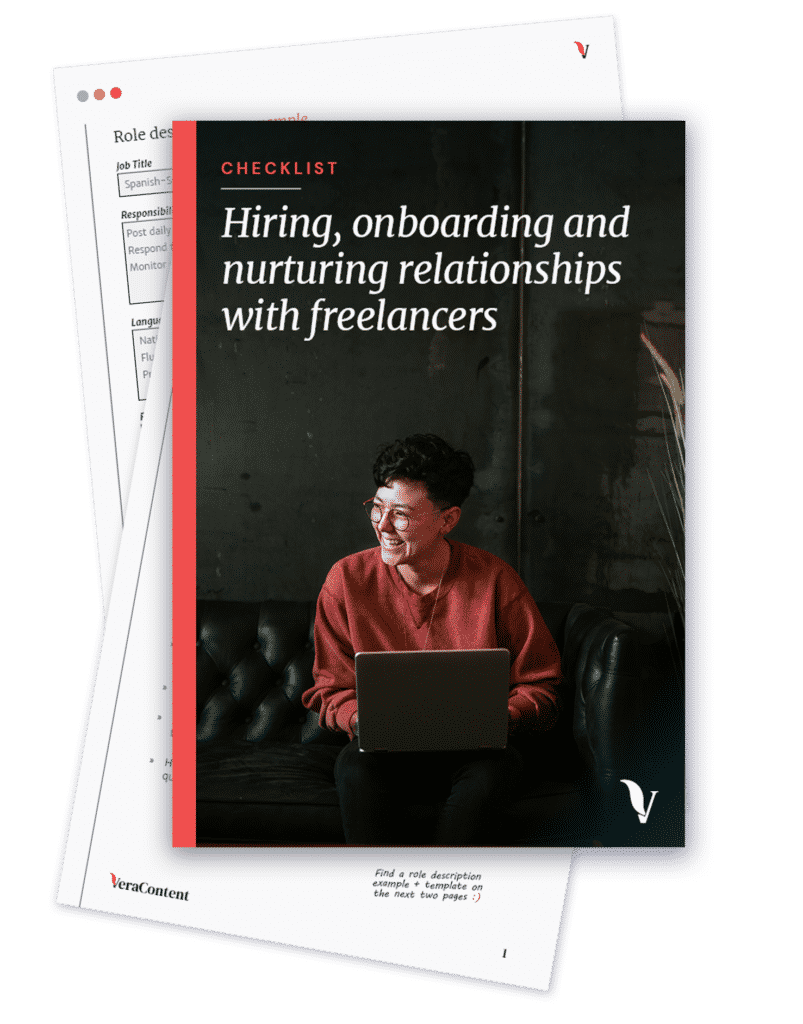
If you decide to go the freelancer route, download our guide to hiring, onboarding and nurturing relationships with freelancers.
How to decide what’s right for your brand
Here’s how to choose which option is best for your team:
| Option | Choose this if… |
|---|---|
| In-house global marketing manager | You have long-term budget for a full department You already have strong internal marketing processes You need deep internal integration |
| Freelancer | You are testing a new market Your needs are short term You require specific channel expertise |
| Global marketing agency | You operate across multiple markets You need both strategy and execution You want structure without building a full department You want marketing leadership without increasing internal management load |
When one person is not enough

Global expansion is not just about producing more content. It is about managing complexity across markets, languages and teams.
Hiring an agency is not simply an expense line. It is an investment in leadership.
You are not bringing in one person to manage and direct. You are bringing in a team that already knows how to create structure, align stakeholders and move your global strategy forward.
At VeraContent, we support international brands with multilingual social media management, marketing translation and localized content creation. Our teams are based in the markets you want to reach, so your content is not just translated but culturally relevant.
If you’re ready for marketing that brings clarity rather than complexity, let’s talk.